
Roca Inc.'s Hartford Young Women's Program
Roca’s mission is to be a relentless force in disrupting incarceration, poverty, and racism by engaging the young adults, police, and systems at the center of urban violence in relationships to address trauma, find hope, and drive change.
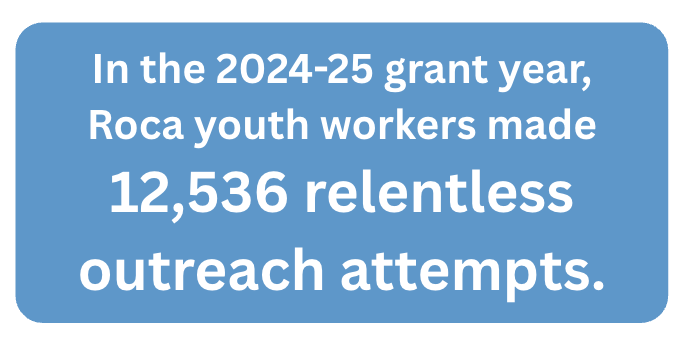
 “Relentless outreach is nonstop,” explains Taylor Spyros, a Senior Youth Worker at Roca Inc’s Hartford Young Women’s Program. “If you slam the door in my face a hundred times, I’m still going to show up that 101st time.”
Taylor works with Hartford’s highest risk young women, many of whom are mothers, who are caught in cycles of trauma and violence. She builds transformative relationships, teaches cognitive behavioral skills to help them better regulate their emotions, and guides them toward safer, more stable futures. But first, she and Roca’s other youth workers need to convince their young people to even be part of Roca’s program in the first place.
“A lot of our girls, they might avoid us. They might not answer you.” Taylor says. “But relentless outreach means calling them, calling their schools, maybe parents, friends. I’ll go into the community, knock on doors, neighbors’ doors, ask if they’ve seen her. I’m trying to find her to show that we are a support, and we’re here to help in any way.”
Relentless outreach often starts with helping young people meet their basic needs. “I’m bringing care packages, like hygiene bags or diapers, to girls we’re trying to get into the program,” she says. “Once you get past that, you build that transformational relationship and it’s like they’ll talk to you about anything. They’ll call you anytime of the day, like, ‘Hey, I just want to chat. I need support. I just want to vent right now.’”
Once there is trust, Taylor leverages it to guide a young woman to make positive changes. “Having those tough conversations comes with transformational relationships. It’s more like you could get to the nitty gritty and really talk about what’s going on and face the adversity that the girls are going through. Telling them, ‘Hey, we need to make some changes. And that’s what I’m here to help you with,’” she says.
 In these conversations, Taylor uses cognitive behavioral techniques to help young people reflect, process, and make better decisions. “We teach the girls brain science and trauma, and we show them, we can rewire our brains. The CBT skills definitely help slow their cycles and let them think before they act.”
“It’s definitely a journey to get there,” Taylor says with a smile, thinking about one young woman in particular. “Lots of ups and downs. Lots of tough conversations. Lots of screaming, crying... but I think that because I was relentless with her, I didn’t give up on her, and I was always there for her, it created a transformational relationship.”