
Domus Kids
Domus builds loving relationships with young people facing adversity, empowering them to pursue their path to self-sufficiency.
 “I was a Domus student at 13 years old,” says Margaret Giron, “with two amazing Family Advocates who were honest, supportive, kind, and showed me unconditional love. Since then, I’ve wanted to be a Family Advocate.”
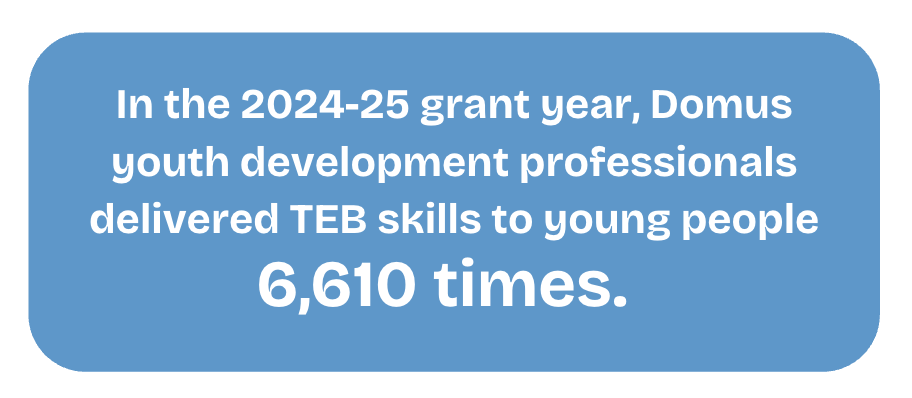
Margaret achieved her goal, becoming a Family Advocate with the Domus Knights School Engagement Program at Stamford High, where she engages 9th graders with school attendance rates between 50% and 85%, or a history of suspension, arrest, or other behavior challenges in school. Over four years, Margaret engages students in intensive, interpersonal relationships to help them build the skills needed to graduate and succeed in post-secondary environments. Domus staff use the Thoughts, Emotions, and Behaviors (TEB) curriculum, which teaches cognitive behavioral skills to help young people regulate emotions and handle challenges.
To support new staff in delivering TEB skills effectively, they participate in weekly training and coaching sessions during their first 10 months that equip them with competencies to teach TEB skills to youth. Then, all staff receive ongoing, bi-weekly supervision with Domus’s Clinical Director to discuss how to leverage TEB skills to support young people on their caseloads.
For Margaret, that means she checks in with her students every morning to ensure they arrive at school and feel confident for the day. “Almost every day I use ‘charge up’ with my students,” she says about one of the five core TEB skills. She learns TikTok dances as a relatable, tangible way to help students internalize the skill. “We take a breather, put on music, and dance. It shifts their energy, then they feel good and go to class. I remind them they can do this anytime without me.”
 “If a student needs to speak with a teacher and they don’t feel comfortable or confident enough, we turn it into a ladder,” Margaret continues, explaining “face fears,” which is another TEB skill. “If talking to a teacher alone is 100% uncomfortable, then emailing them is 80%, talking with me in the room is 50%, and if I do the talking while they watch, that’s 0% – they’re comfortable with that. So, then the next time something is going on, you already did it with me so now it’s your turn. Let’s go up the ladder of discomfort instead of down.”
In a role where trust is everything, Margaret builds skills by showing up every day without judgment. “It’s about consistency, compassion, and being someone they can count on,” she says. “I want to make students feel how my family advocates made me feel – seen and heard.”