
Performance Report
In CTOP’s organizational development work with our grantee partners, our north star is to help young people change their lives by successfully reconnecting to education and gainful employment on a pathway to self-sufficiency. Before organizations can produce these outcomes for young people, they must first build their capacities and competencies to be able to do their work effectively, reliably, and sustainably, which requires an investment of organizational time and effort measured in years, not weeks or months. As a result, while we do not expect partners to generate the kinds of long-term outcomes we ultimately care about in the first few years of our work together, we are starting to see those outcomes now and, with our partners whose organizational capacities and competencies are most developed, are beginning the journey to validate those outcomes via external evaluation.
Succeeding in Education and Employment
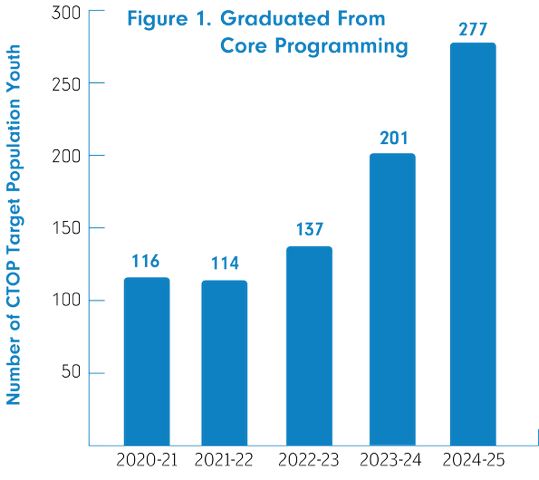
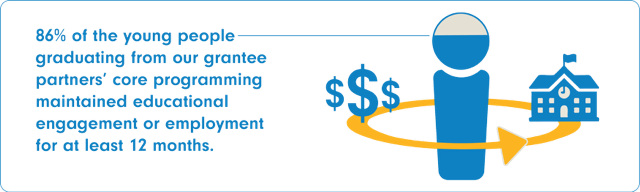
CTOP’s Key Performance Indicator (KPI) that provides the ultimate measure of our grantee partners’ success, toward which CTOP has contributed and for which CTOP holds itself accountable in terms of monitoring its own performance, is the number of youth in CTOP’s target population who are still actively engaged in school or employment 12 months following their graduation from a CTOP grantee partner’s programming. In aggregate across our grantee partners, the number of young people attaining this critical milestone was 173 or 86% during the 2024-25 grant year. For all of our grantee partners, their definition of program graduation requires that a young person has graduated high school, enrolled in postsecondary education, or secured employment, which means that CTOP’s KPI that aggregates the number of young people graduating from our grantee partners’ programming reflects not simply an output, but a critical outcome. In 2024- 25, the number of young people graduating from our grantee partners’ programming was 277, up from 201 last year.
What Are Young People Getting from their Programs?
In contrast to looking at the number of individuals served by a program – which is a widely-used metric in the social services sector that actually doesn’t convey any meaningful information about the social value a nonprofit is helping to create via services delivered – CTOP uses a KPI called the active program slot. To be considered in an active program slot, a young person must 1) meet the program’s target population enrollment criteria, and 2) receive the kinds and levels of services that the organization’s theory of change identifies as necessary to ensure that the young person will truly benefit by ultimately attaining the program’s long-term outcomes.
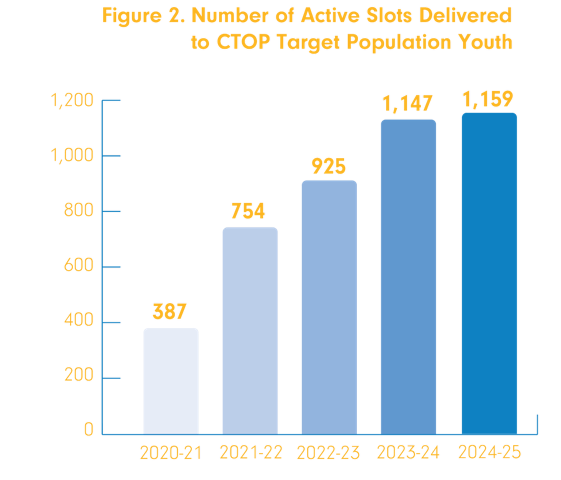
In each year of implementing CTOP’s social investment strategy, the number of active program slots that our grantee partners have produced, in aggregate, has continued to climb, reaching 1,159 in 2024-25 – even though only some of our grantee partners have reached the stage of organizational development where they are producing active program slots. The number of active program slots delivered in any given year continues to be significantly higher than the numbers of young people graduating from our grantee partners’ programs and attaining long-term outcomes. These data align with our expectation that because of the extent and complexity of the barriers our young people face, they will often participate in programming for more than one year, which by definition means that only a fraction of youth enrolled in active program slots in any given year would be expected to have made the progress necessary to graduate in that year.
Highlights from External Evaluation
As two of CTOP’s grantee partners with the most developed organizational capacities and competencies, Domus Kids and Our Piece of the Pie have launched implementation and outcomes evaluations with Child Trends, which is the leading research organization in the United States focused on improving the lives of children, youth, and families. Through these engagements, Domus and Our Piece of the Pie are leveraging the expertise of Child Trends to assess their readiness for external evaluation; take stock of the quality of the evidence base underlying the design of their program models; understand and improve the fidelity of their program implementation; and validate the outcomes they are delivering for young people. Child Trends is currently cleaning and organizing Our Piece of the Pie’s data in preparation for their outcomes analysis and just completed the outcomes analysis for Domus.
In its outcomes analysis for Domus, Child Trends found that 60% of all students who ever enroll in the Domus school engagement program successfully exit and attain long-term outcomes one year later, maintaining post-secondary education and/or employment at the 12-month mark following program graduation. Child Trends further found that the delivery of face-to-face services in the Domus school engagement program is positively associated at the 95% confidence level with the following, with these associations persisting even after controlling for differences in students’ backgrounds and the barriers they had encountered:
- Student attendance at school;
- Promotion to the next grade level;
- Successful program exit upon high school graduation; and
- The attainment of long-term outcomes a year following program graduation.